The Bank of Japan’s surprise decision that they would raise their benchmark interest rate cap from 0.25% to 0.50% sent ripples through the global financial markets. Since 2016 the Japanese Central Bank has set its target range for the yield of 10-year Japanese government bonds near zero, with a cap of 0.25%.

Gold began the trading week moving lower as market participants continue to digest and react to last week’s FOMC statement and economic projections. In essence, the Federal Reserve made it clear that they are committed to reducing inflationary pressures by continuing to implement rate hikes and then maintaining those elevated rates throughout the next year.

Two major events this week resulted in a roller-coaster ride for gold investors and traders.

Apparently, it took a day for investors to fully digest and react to yesterday’s FOMC statement and updated economic projections for 2023 – 2025. Chairman Jerome Powell did not mince words yesterday delivering an exceedingly tough and hawkish written statement as well as responses to reporter's questions.

As expected, the Fed announced its decision to raise its benchmark rate by 50-bps. This takes the central bank’s “Fed funds” rate to between 425 - 450 bps (4 ¼% - 4 ½%). However, it was Chairman Powell’s comments regarding his policy outlook during the press conference that garnered the most attention.

Today the U.S. Bureau of Labor Statistics released the CPI index report for November. The report showed that inflation remains elevated above 7%, but has declined substantially, coming in at 7.1% year-over-year in November.

EDITORS NOTE: On today's video we will present an interview that was recorded last Friday. It was released today but still offers a comprehensive overview of my take on gold pricing, and inflation.

__________________________

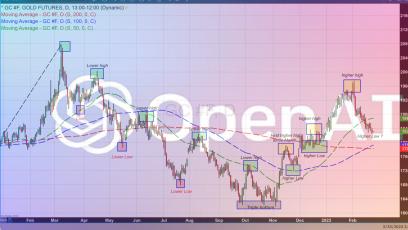
Market technicians unanimously agree that the 200-day moving average is the line in the sand when it comes to technically determining if gold (or any other stock or commodity) is in a long-term bullish or bearish trend. While it is the longest time cycle typically used in moving averages it is been the accepted “go-to “study to determine the current long-term trend of a market.

Unlike yesterday’s double-digit gain in gold prices, today we see gold once again consolidating as it did on Tuesday. Tuesday’s price consolidation in gold indicated that the dramatic decline that occurred on Monday was more akin to a one-and-done scenario than the beginning of a correction. It was the equal or slightly higher low on Tuesday that was just as important as the fractional gains.

Gold futures basis the most active February 2023 contract opened in New York at $1783.30 and traded to a high of $1803.20 just above its 200-day moving average which is currently fixed at $1800.70. The price point of this long-term moving average at least for the short term became a technical level of resistance moving gold back below it.